Celebrating the 20th anniversary of ‘Earth Hour’, Leo Burnett Sydney’s finest hour
The first Earth Hour took place on Saturday, 31 March 2007, in Sydney, Australia. More than 2.2 million people and over 2,000 businesses switched off their lights for one hour, with iconic sites like the Sydney Opera House and Harbour Bridge going dark. The event, created for the World Wildlife Fund by Leo Burnett Sydney, and backed by Fairfax Media and Sydney Lord Mayor Clover Moore, aimed to demonstrate public concern to a climate-skeptical government and succeeded beyond expectations, generating worldwide media attention.
Many people over the years have claimed credit for the first Earth Hour campaign but for the record the key players at Leo Burnett were national creative director Mark Collis, creative group head / art director Mike Spirkovski, senior writer Grant McAloon, Planning Director Todd Sampson, Group Business Director Hazel Livingstone, Account Managers Jodi McLeod and Sam McGown, Managing Director Tim Castree, Chairman Nigel Marsh. Client Executives: Andy Ridley and Liz Potter.
In a linkedIn post, Spirkovski recalls how the name Earth Hour came to be:
Back in 2007, in the offices of Leo Burnett Sydney in McMahons Point, a few of us were working on a brief for WWF.
Somewhere in the middle of that, Grant and I were throwing around ideas and names for this thing. Then two words came together.
Earth Hour.
We put together a simple mark. A globe inside a 60, with Earth Hour underneath. We embossed the hell out of it. Probably more than we should have. It took weeks to get there, which says a lot about the time. It looks simple, but a lot of work went into getting it to feel that way. You still see it today.
At the time, it didn’t feel like much. Just a simple idea to turn the lights off for an hour and see the difference you can make.
No one thought it would still be around 20 years later.
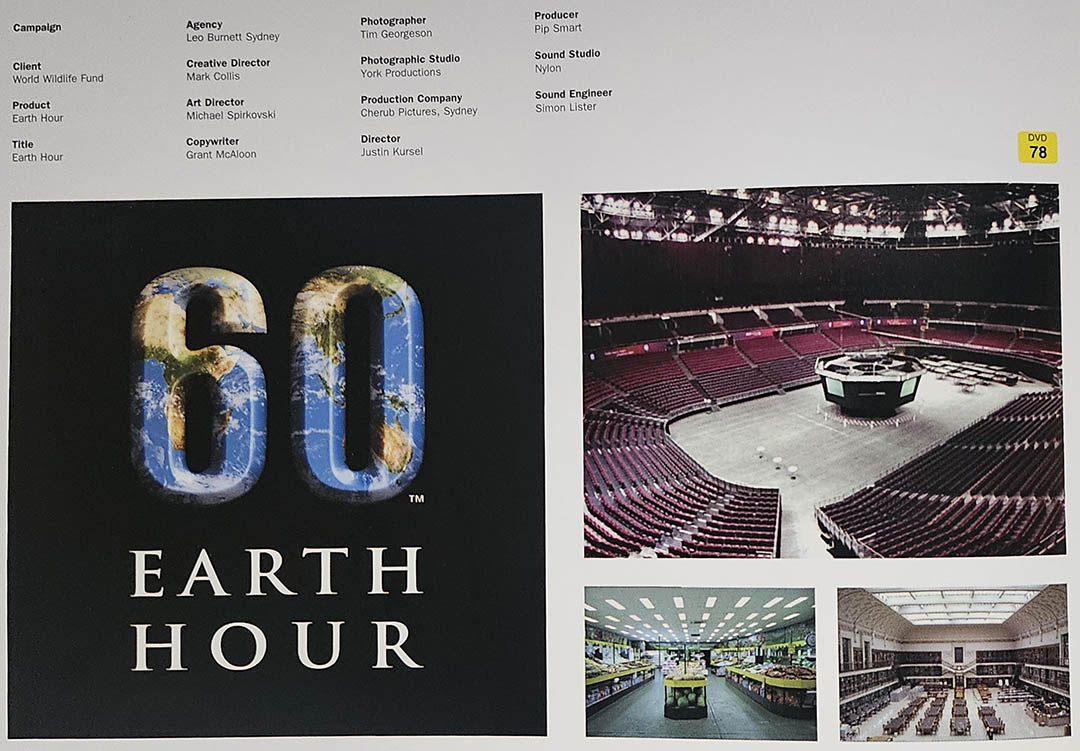
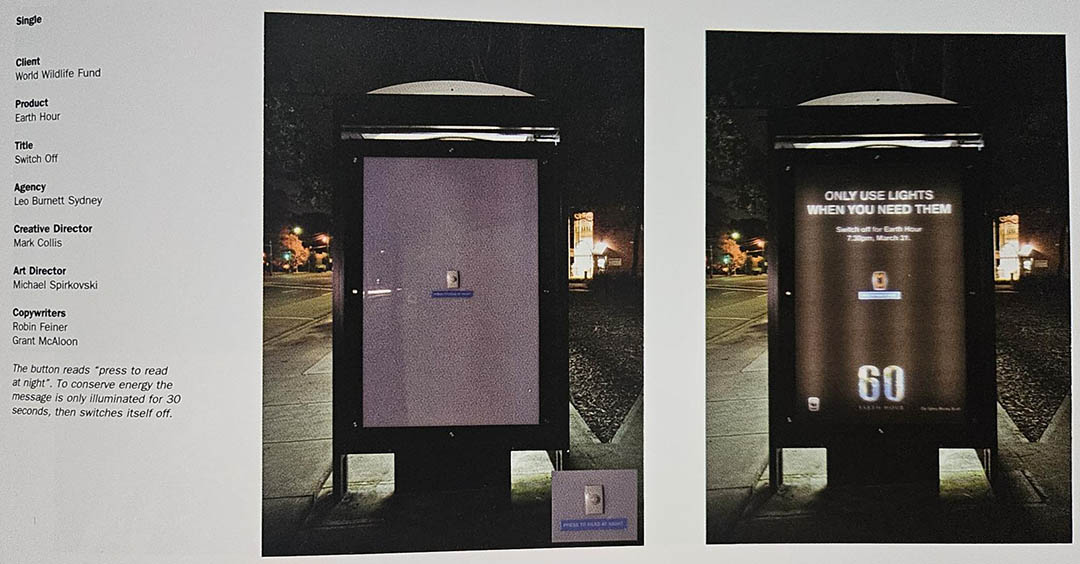
The Earth Hour campaign, as featured in Campaign Brief’s The Work 07 [above], went on to win multiple awards around the world throughout 2007 and 2008 including two Gold Lions and a prized Titanium Lion at Cannes Lions in June 2007; a Gold Pencil at The One Show; the Grand Prix and Gold Effie at the Australian Effie Awards; the Platinum (top award) at the AME Awards; the Grand Prix (Media) at Spikes Asia; the Grand Prix at WARC Innovation Awards; The Banksia Award (top award) at the Banksia Environment Awards. Earth Hour was also recognised by The Gunn Report as one of the most awarded campaigns in the world.
2008 (29 March): Earth Hour expanded internationally. About 50 million people in 35 countries participated, with over 400 cities involved. Major landmarks went dark, including the Golden Gate Bridge in San Francisco and the Colosseum in Rome. Google darkened its homepage, and cities like Bangkok, Chicago, Copenhagen, and Toronto joined.
2009 (28 March): The event was branded “Vote Earth” and positioned as the “world’s first global vote” ahead of the UN Climate Change Conference (COP15). Participation surged to 88 countries and over 4,000 cities, with an estimated one billion people involved worldwide. It was widely described as the largest grassroots environmental movement at the time.
Earth Hour continued to scale rapidly: By 2010, it reached 128 countries/territories and over 6,000 cities, with more than 1 billion participants.
Participation peaked in the late 2010s, with 188 countries/territories and nearly 18,000 landmarks in 2018, and similar high numbers (around 187–192 countries) in subsequent years, including during the COVID-19 pandemic in 2020.
The movement has extended beyond the symbolic hour to drive real-world outcomes, such as petitions for stronger environmental laws (e.g., ocean and forest protection in Russia), support for biodiversity agreements, and broader advocacy. It has engaged all seven continents, including research stations in Antarctica.
In recent years, the focus has shifted toward the “Biggest Hour for Earth” (launched around 2023), encouraging people not just to switch off lights but to “Give an Hour for Earth” by dedicating 60 minutes to positive actions like connecting with nature, learning, or environmental projects. This ties into goals like the 2030 targets for nature protection and restoration.
Participation metrics include millions of “hours given” pledged via an “Hour Bank” — nearly 3 million hours in 2025 (doubling prior records), with strong social media trends across dozens of countries.
Earth Hour 2026 fell on Saturday 28 March (8:30 p.m. local time) marking two decades since its Sydney origins. The official site highlights it as a celebration of collective action and storytelling from communities worldwide.
Register for FREE HERE and receive the Campaign Brief Daily Bulletin and/or the global Best Ads Best of the Week Bulletin. Subscribe to Campaign Brief Magazine.
#More Creative News #No paywalls #No annual membership fees
Subscribe to Portfolio & Reel for current listings of Australian and NZ ad agency and production company leadership and key personnel
1 Comment
The story behind Earth Hour was extraordinary – pre Leo Burnett’s involvement the working title was the Big Flick, and was developed as a means of illustrating that people did want action on climate change at a time when the climate sceptic government of John Howard was in power. Liz Potter, myself and Jacqui McArthur shared the idea with Nigel Marsh and Todd Sampson from LB at a breakfast at the Hilton. We had previously pitched the idea for funding with NOKIA, who were keen to partner, but then they went into a global meltdown and imploded, the idea was shelved until Nigel set me up with a meeting with Phil McLean (his neighbour), the then Group Editor at Fairfax. After a very old school lunch and with many crown beers and then many more beers, Phil helped reshape the idea into something that he was convinced the Sydney community might buy into – at the centre of this the idea went from a from of protest to an idea driven by hope, not fear. It was the combination of WWF, Fairfax and LeoBurnett bringing their combined talents together that turned the idea into something that touched the lives of so many people across the planet. It was also the extraordinary efforts of the local community that drove the success, we designed the project so that there as no individual hero, but many heroes from all walks of life and we developed a brand that belonged to everyone. At the time it was incredibly controversial inside WWF to create an open source brand, that belonged to the people but it worked. My boss, Greg Bourne, who not only let us loose to build Earth Hour but also designated funds to run it, made it very clear to me that this needed to be thought of from the get go as global idea, and it was that advice that meant we moved the original date from November 2006 to the equinox on March 2007 with the idea that we wanted to be able to pull off Earth Hour al over the world at it was that date that would put most cities in the dark by 8pm on Saturday night at the end of March. As the article says many people take credit for Earth Hour – but in the end it was a unique combination of citizens from many walks of life that did it and in what seems very unusual in this day and age we wanted everyone to be Earth Hour heroes. 20 years on it is still evidence that people have incredible power when they act collectively behind a common purpose. A sentiment that’s worth remembering more than ever in today’s chaotic world.