Manifest Group launches Cultural Velocity – the first measure of a brand’s cultural impact

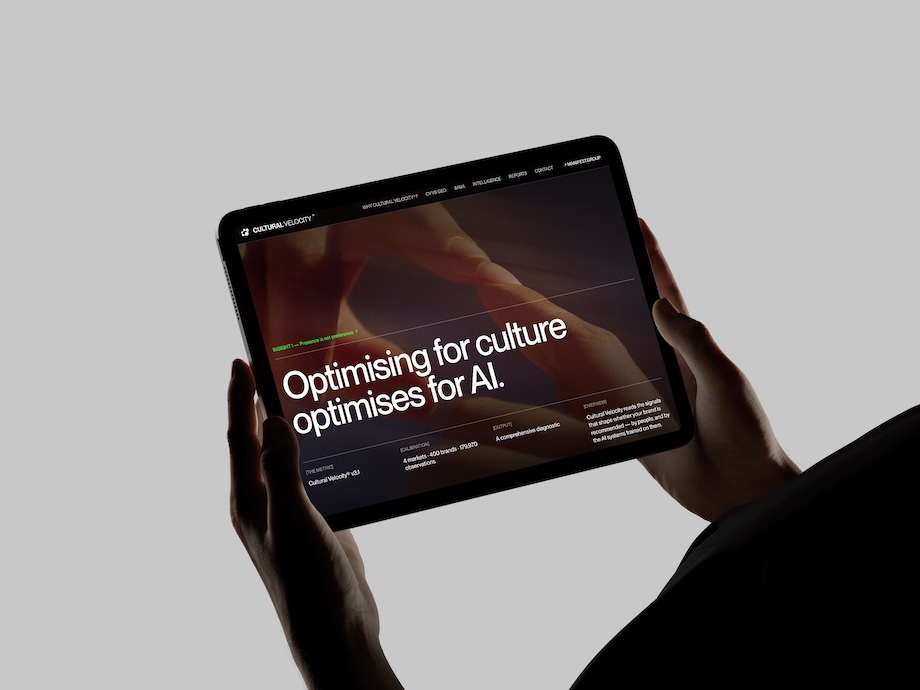
Global independent brand communications agency, Manifest Group has launched Cultural Velocity®, the first measure of a brand’s cultural impact and its influence on AI recommendation. The new diagnostic is built to understand and optimise brand communications for both human audiences and the AI models increasingly answering on their behalf.
“Cultural Velocity is the first credible, empirical measure of a brand’s cultural impact,” says Alex Myers, founder and CEO at Manifest Group. “We’ve always known cultural relevance is an unfair advantage for brands, but its direct connection to AI recommendation surprised even us.”
The research used to calibrate Manifest’s Cultural Velocity engine collected 179,970 answers from ChatGPT, Claude and Gemini across ten benchmark categories, four regions and 400 brands. The brands with a high Cultural Velocity were 86 per cent more likely to appear in relevant prompt responses. In some categories, being in the top quartile of a Cultural Velocity league table meant they were more than two-and-a-half times (2.52x) more likely to appear in AI recommendations than less culturally relevant brands.
GEO is ‘getting it wrong’
The findings challenge the assumptions of the emerging ‘GEO’ (generative engine optimisation) industry, which promises AI recommendation through readability, schema markup, content volume and message consistency.
While these markers show some influence in the Cultural Velocity study, it pales in comparison to the verified cultural signals measured across the new instrument’s four pillars: Imprint, Magnetism, Momentum and Acceleration.
Significantly, the results show owned-page optimisation alone did not move the signals that convert to recommendation at all. Coverage volume, also often discussed as an influence on AI visibility, fell flat compared with cultural relevance. Mercedes-Benz — the most-mentioned brand in the entire study, with twice Toyota’s coverage in the vehicle brand cohort — was recommended in just 7% of prompt responses, against 67% for Toyota.
Says Myers: “GEO, in many cases, is a desperate attempt to recast SEO tactics for a post-algorithmic world. The truth is much of the advice is getting it wrong. Although all categories have their own cultural fingerprint, across them all, AI isn’t conducting an algorithmic empirical search, but a culturally derived vibe-check.”
PR leads, but not on its own
The Cultural Velocity research logged 23,861 individual URLs being read by the three LLMs to find their recommendation, and 62.9 per cent were from ‘earned media’ sources, reflecting the confidence of the PR industry that AI optimization through cultural relevance is an ownable field, but this is ‘naive’ according to Myers:
Says Myers: “Cultural impact is delivered by any media necessary. Earned media signals outweigh others and provide the spine for trust and credibility, as well as immediate relevance. But PR content is never read in isolation; it is corroborated with social media content and forums, calibrated with owned media prioritisation and retail availability can have a binary influence on inclusion, even if cited with less frequency.
“PR agencies claiming they can lead an AI optimisation strategy through earned coverage alone are kidding themselves and their clients. Our results confirm those agencies need to become literate in omni-channel strategy to deliver on those claims.”
An omni-channel diagnostic
More than a score, Cultural Velocity is a diagnostic — showing which signals a brand over- or under-indexes on. The pillars of cultural influence Cultural Velocity measures are:
Imprint: how deeply and consistently a brand is written into the cultural record.
Magnetism: the meaning attached to a brand, and whether this wins in comparison with the category.
Momentum: the pace and pattern of conversation around the brand – is this increasing or decreasing?
Acceleration: the expansion of the brand into new contexts, audiences and markets.
Says Aaron Maughan, Intelligence Director at Manifest Group: “The IMMA framework means Cultural Velocity isn’t just an arbitrary score, but a diagnostic. We can read and measure which pillars move recommendation in each category, and where a brand over or under performs, so we can map how to improve its Cultural Velocity and with that its presence in LLM responses.”
More information is available at cultural-velocity.com, where brands can request a free Cultural Velocity scoring preview and download the full white paper covering the research findings, ‘The Recommendation Machine’.
Register for FREE HERE and receive the Campaign Brief Daily Bulletin and/or the global Best Ads Best of the Week Bulletin. Subscribe to Campaign Brief Magazine.
#More Creative News #No paywalls #No annual membership fees
Subscribe to Portfolio & Reel for current listings of Australian and NZ ad agency and production company leadership and key personnel